


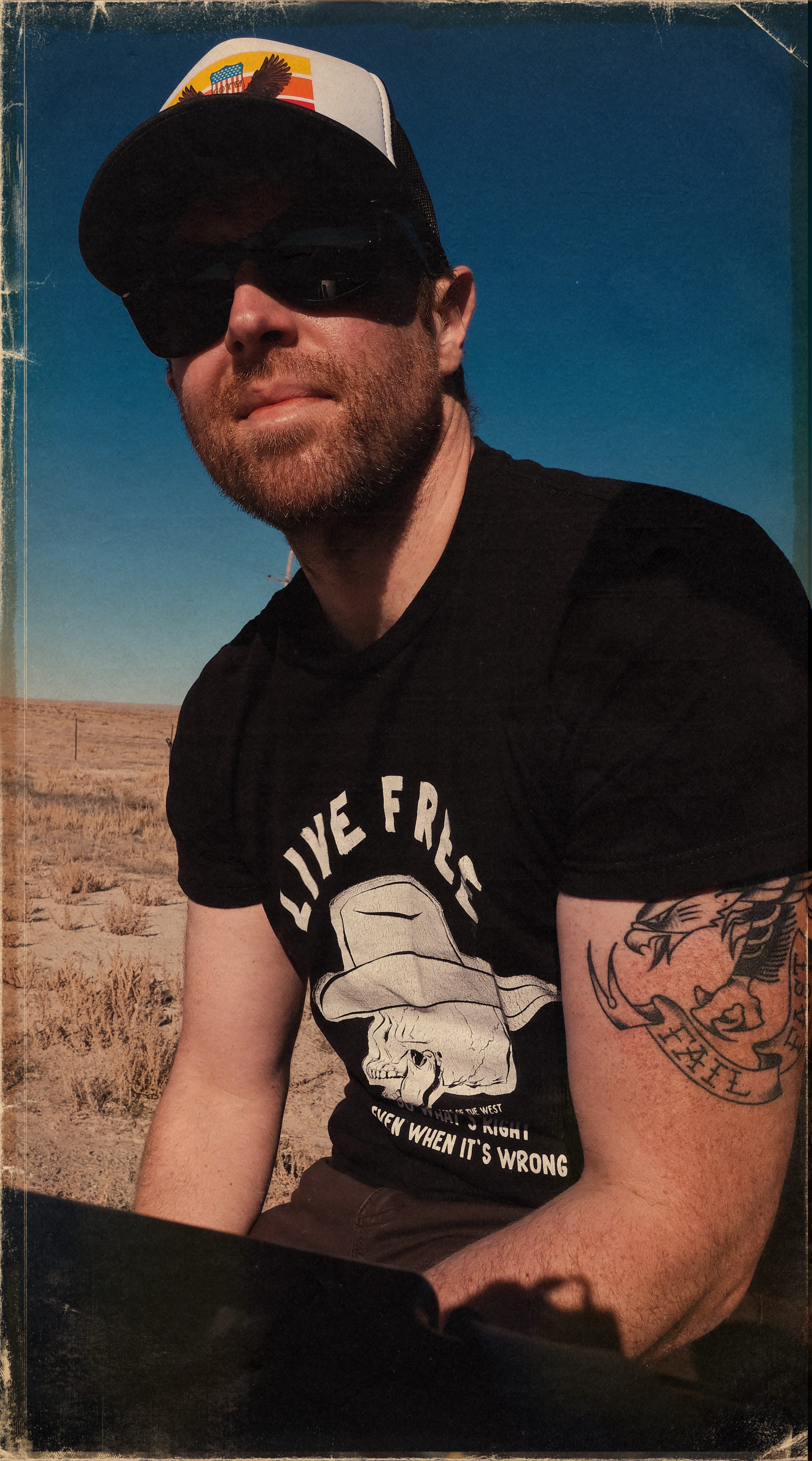
I. The Realization
Most of my life, I wasn’t trying to be special. I was just trying to be normal while failing at it in ways I could never explain. My first mistake was in thinking that everyone had a brain like mine and everyone was just better at being human than I was.
It’s taken me this long to realize that I wasn’t operating on the same hardware.
Nor was I failing at being human. I was simply building a system to survive being me.
Recently I’ve been retracing the path of my life that led me to this moment, and specifically, to starting Code of The West.
It didn’t come with a breakdown. No grand moment of catharsis. Just… a shift. A new variable in the equation. Like the system finally returned a value that made the whole thing compute.
II. Backtrail
I can remember being ten years old, sitting in a coffee shop with a blank notebook in front of me. I wasn’t writing most of the time though. I was thinking. Observing. Listening. Running scenarios in my head. I’d make notes as realizations presented themselves, but I mostly had the notebook there because I recognized it would look strange otherwise to see a little boy staring off into space for extended periods of time.
Other kids played pretend. I ran simulations. It just looked like daydreaming whereas to me it felt like survival. I wasn’t imagining fantasy worlds. I was prepping. For conversations I hadn’t had yet and mistakes I had yet to make. For social situations I didn’t understand but knew I’d be expected to navigate.
My mind naturally turned toward if-this-then-that. Not in the abstract, but in lived terms. If someone says this, how do I respond? If their face shifts, what does that mean? If the energy in the room dips, what caused it? These weren’t passing thoughts. They were patterns I studied. I thought everyone did this, I just thought I was just slow at it.
To put it bluntly, I thought I was bad at being human.
There were other clues, too, Ones I didn’t have a name for at the time.
When I started learning to fight later in life, I couldn’t “just throw a punch.” I had to be walked through every part of the motion: pivot the foot, activate the hip, let the shoulder carry the arm. From the ground up. No part of it was intuitive. But once the chain was understood, I could execute it cleanly, repeatedly, efficiently.
Same with engines. Or writing. Or design. Or conversation.
Give me the mechanics, and I’ll master them, but don’t ask me to feel it. Don’t ask me to “just do it.” It’s not that it just never worked, it was also incredibly frustrating to be told that. It felt like a reminder of why I was broken.
Even the arts, the things I was supposedly good at like drawing, were systems I broke down.
See, it’s always been about fluency for me. The more mental pathways I prebuilt, the faster I could access them under pressure. The trick wasn’t reacting. The trick was having enough rehearsed permutations that it only looked like reaction. Fighting was the same. Watch the hips, not the hands. Recognize the initiating motion. Don’t predict, just prepare enough that you don’t have to.
I’ve described it before like this: if a mind is like an engine, and I know my redline is at six thousand RPM, I feel like I constantly idle at thirty-five hundred. Always close to acceleration, never fully at rest.
I didn’t know that wasn’t normal. I just thought I was too tightly wound, too serious, too tense.
But it wasn’t tension, it was the way my system ran.
III. The Misdiagnosis of Normalcy
For most of my life, I operated under one simple but corrosive assumption. That I have the same brain as everyone else, I’m just worse at using it. That assumption shaped my guilt over inconsistency, shame about routines I couldn’t keep and a confusion at how hard simple things seemed to be.
So I spent decades trying to make myself “better.” More organized. More focused. More like… them, whoever they were.
I told myself I lacked discipline. I lacked drive. Even as I was learning to make comics on my own, and eventually writing books, dissecting engines, reassembling my own psychology in real time and eventually building AI systems, I still believed I just wasn’t doing “being human” correctly.
That’s the real cost of believing you’re normal but bad at it. Everything is hard.
I never stopped to ask “What if the structure of my mind isn’t broken—what if it’s just built for a different task?”
I used to think my strengths were flukes. That being good at systems, at strategy, at storytelling was my way of compensating for a faulty core. I didn’t feel “special.” I felt deficient. Like everyone else was given the same hardware and somehow I just didn’t get the operating manual.
My inability to make the bed, eat healthy regularly, maintain internal order felt like character flaws. Gaps in an operating system I thought I was supposed to already have. So much so that when someone did compliment me or express some admiration for something I had done, my immediate tendency was to deflect from it. Not because of humility, but because inside I saw it as a fluke, not a function.
It’s only been in the past couple of years that I’ve started to understand these aspects about myself. That perhaps what I thought were symptoms of failure were actually adaptations. What I thought was dysfunction was design.
IV. Structural Fluency
If I have a strength, it isn’t an innate talent. It’s cohesion.
I don’t know if I’m smart in the conventional sense but I do know now that I’m fluent in structure.
That’s why I can break down a fight the same way I break down a story. Why I can analyze an emotional conversation using the same framework I’d use to reconstruct a disassembled engine. Why I’ve always been able to move between art, code, philosophy, business and it doesn’t feel scattered to me. It feels integrated.
Other people seem to move through the world by feel. They pick things up intuitively. Sense where to go next. They rely on something innate. I don’t. At least not in the same way. I had to bootstrap my sense of this.
If I can’t understand something, I map it. When I can’t sense something, I model it. And if I can’t intuit it, I reconstruct it from scratch until it holds.
That’s why systems don’t intimidate me. They feel honest. They respond to pressure. They reveal their logic if you ask the right questions. It’s why AI isn’t overwhelming to me. It’s just another language. Another mirror. Another attempt to understand how complex behavior emerges from structure.
That instinct didn’t come from confidence.
It came from necessity.
I didn’t learn to build structure because it was fun. I learned because I didn’t have it and I couldn’t function without it. The irony now is that my work arounds I built like the obsessive scaffolding, the constant pressure to make sense are what other people now see as my “gift.” But it never felt like a gift. It felt like holding my brain together with rope and prayer. Until one day, I realized that the scaffolding wasn’t makeshift. It was architecture.
And I was the one who built it.
V. Integration
There were always two tracks running beneath my life.
One was internal built of thought-loops, simulations, mental scaffolding from sitting in cafés at ten, war-gaming friendships. Practicing fluency in private so I wouldn’t fall apart in public.
The other was physical. Working on trucks over the road with my dad. Learning construction and trades with my stepdad. Riding dirt bikes. Breaking down engines. Tearing things apart so I could understand how they held.
Despite the obvious fact that I was the one engaging in these myriad activities, I never thought that the sort of recursive mind I had and the hands-on knowledge from my upbringing could belong to the same person. In large part because the world doesn’t seem to like things that aren’t easily categorized and so I always saw it as there needing to be a necessary bifurcation. In so small part since I’d never encountered someone who embodied them both.
But I did.
What I couldn’t see until much later in my life was that these weren’t separate lives. They were two halves of the same pattern recognition engine.
The internal world taught me how to map complexity while the external world taught me how to endure it.
And somewhere along the line through muscle memory, grease, repetition, and code I started to understand that the life I was building didn’t have to look like anyone else’s.
That’s what makes the Code of the West not just a project.
It’s not really branding or content. It’s the convergence point of the world I built to survive and the world I inherited from the men who taught me how to build with my hands.
When I wrote the first version of the Code in 2021, I thought I was offering people a compass but the truth is I was articulating my own.
Not just a set of values. But a structure. A rhythm. A way to live with the weight of being wired differently without apology.
That was the moment the scaffolding turned outward and the systems I built for myself became something other people could use.
VI. Acceptance
For a long time, I thought the goal was to become normal.
Not in the performative sense, not to fit in but just to function the way other people seemed to.
To get up early. Make the bed. Maintain habits without internal resistance. Talk to someone without thinking through every possible variable in the interaction. Just… be.
And because those things didn’t come naturally, I assumed I was failing at a shared blueprint.
It never occurred to me that maybe I wasn’t broken and that maybe I just wasn’t built the same.
I used to think there were only two lanes, People who functioned and people who couldn’t and I put myself in the second camp. Not because I lacked capability, I knew I had grit. But because it always felt like I had to fight for the things that others seemed to have been born with. But now, I think there’s a third category.
A lane where fluency doesn’t come from instinct but from construction. Where you don’t feel your way through life, you engineer your way through it. Where your sense of coherence isn’t ambient, but earned.
That’s the lane I live in.
Not normal or abnormal. Not genius or deficient. Just… me.
The kind of mind that doesn’t idle and can hold contradiction without flinching. A mind that had to build its own scaffolding because without it, the whole thing would collapse.
I wouldn’t trade it now.
Even with the exhaustion and the tension and how hard it’s been to feel seen.
Because my brain-this pattern engine, this overclocked CPU, this lens that never shuts off-
It’s mine.
And I’ve finally stopped trying to replace it.
VII. “Me.”
I used to think the real work was getting better.
Better at waking up. Better at planning. Better at being whatever it was I thought “a functional person” looked like.
But the real work wasn’t about becoming someone else. The deeper work was about finally seeing who I already was.
I was just living in the absence of a system I had to build from the ground up. Now that it’s built, I can see it for what it is. I’m not just a patchwork or a mask, or a malfunction. I wasn’t lazy and scatter brained, or bad at being human.
I just needed a structure that could hold. One that I made. One I offer to others now. Not as a map for their lives, but as proof that building your own is possible.
I wouldn’t trade minds with anyone else.
Because this one, the one that I’ve worked so hard to understand, that doesn’t shut off, the one that sees too much, the one that has had to work twice as hard to move through the world is the one that also sees the pattern beneath the noise.
It made the Code.
And it made me.
You were never broken, you were navigating life with the tools you were handed, but wish you could have used your own.
Your words have spoke to me so many times- thank you for living out your human design and code.
Great stuff. I am going to check out your book. I worked on a remote ranch in Northern British Columbia. Curious to see how your code relates to mine.